Inside the Orchard OCD Conference 2026: Future Treatments
Quick summary
- The Orchard OCD Conference 2026 (4–5 June, London) brought together many of the world’s leading OCD researchers to chart where treatment is heading.
- Most of the excitement sits in three areas: precision medicine and biomarkers, neuromodulation (including deep brain stimulation), and psychotherapy beyond standard ERP, including digital and AI-assisted approaches.
- Almost none of it changes first-line care yet: exposure and response prevention (ERP) and SSRIs remain the treatments with the strongest evidence and the widest access.
- The most useful idea I brought home was not a device or a drug. It was the renewed case for earlier detection and treatment.
- Below you’ll find my “Three Horizons” framework for placing any treatment headline into context, plus questions to ask before chasing the next breakthrough.
What you won’t find elsewhere Most coverage of research conferences either lists the talks or hypes a single “miracle” treatment. This piece does neither. I’ve translated two days of frontier science into a practical framework — the Three Horizons of OCD Treatment — that you can use to decide whether a given headline is relevant to you, right now. I’ve also included an anonymised composite from my own practice and one conclusion that runs against the usual conference narrative.
What was the Orchard OCD Conference 2026?
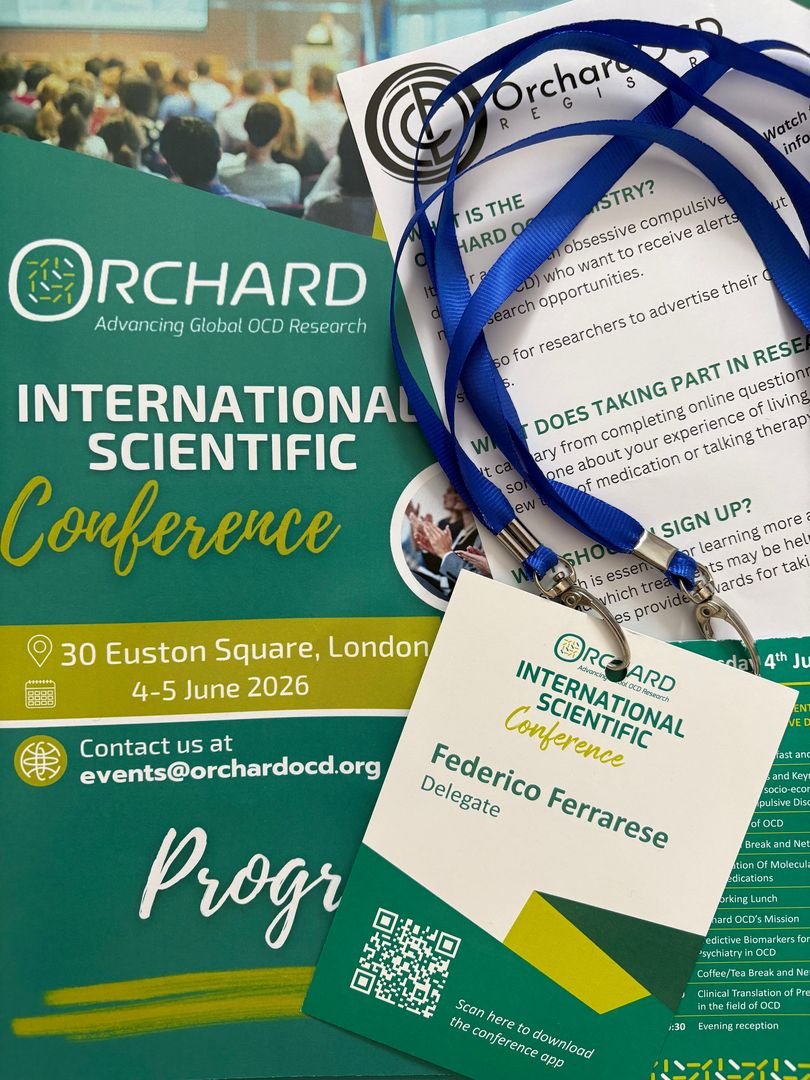
The Orchard OCD Conference 2026 was an international scientific meeting held on 4–5 June at 30 Euston Square in London, organised by the charity Orchard OCD and supported by a Wellcome Trust award. Its purpose was to take stock of global OCD research and ask a single, urgent question: how do we turn decades of neuroscience into treatments that actually reach people?
I sat in the audience for two full days. Day one was framed as the “state of the art” — the neural basis of OCD, the hunt for molecular targets, biomarkers, and precision psychiatry. Day two was about delivery: neuromodulation and neurosurgery, psychotherapy breakthroughs, and the launch of the first international guidelines for managing OCD. The closing plenary, on accelerating progress, was led by Naomi Fineberg and Trevor Robbins.
I came to Orchard with one foot in each world: an MSc in Applied Neuroscience, so I could follow the science on its own terms, and a clinic full of real people, so I never lost sight of why it matters. That dual lens is what I’ve used here — translating two days of frontier research into the only question that counts for you: what does this mean for my recovery?
For context, OCD is more common than most people assume. The largest US epidemiological survey put the lifetime prevalence at around 2.3%, with symptoms typically beginning in late adolescence (Ruscio et al., 2010). It is defined by intrusive, unwanted thoughts, images or urges (obsessions) and the repetitive acts or mental rituals people use to neutralise the distress they cause (compulsions) (American Psychiatric Association, 2022).
What does the “future of OCD treatment” actually mean right now?
Here is the honest answer: for most people reading this, the future changes very little about what you should do today. The treatments with the best evidence are still the ones we’ve had for years. What’s changing is the map — the range of options for people who don’t fully respond to first-line care.
To stop the headlines from feeling overwhelming, I use a simple model with my own clients. I call it the Three Horizons of OCD Treatment.
Horizon 1 — Here and now. Treatments that are proven, recommended, and accessible. This is ERP-based CBT and, where appropriate, SSRI medication. UK guidance still places these at the centre of care (National Institute for Health and Care Excellence, 2005), and meta-analyses continue to show that CBT with ERP produces large reductions in OCD symptoms (Olatunji et al., 2013; Öst et al., 2015). If you haven’t yet had a proper ERP course, this is your starting point — full stop.
Horizon 2 — Emerging and specialist. Options that exist, work for some people, but are reserved for specific situations: intensive or residential ERP programmes, non-invasive brain stimulation such as repetitive transcranial magnetic stimulation (rTMS), and guided digital therapy. These are real, but they’re add-ons or alternatives for particular cases, not replacements for Horizon 1.
Horizon 3 — The frontier. The research featured most prominently at Orchard included deep brain stimulation, focused ultrasound, novel drugs acting on the glutamatergic system, biomarker-guided “precision” treatment, and AI-assisted therapy. Genuinely exciting. Mostly years from your local clinic.
When you see a story about a “new OCD treatment,” the first job is to work out which horizon it belongs to. Most distress about treatment news comes from mistaking a Horizon 3 idea for a Horizon 1 option you’re somehow missing out on.
Precision medicine, biomarkers and AI: can we predict who gets better?
Precision medicine in OCD means using biological and cognitive markers to match each person to the treatment most likely to help them, rather than working through options by trial and error. Much of day one was devoted to this goal, and it’s where artificial intelligence is starting to earn its place.
Researchers presented work on brain imaging, genetics, and electrophysiology as potential predictors of who responds to what. Several talks focused on computational psychiatry and machine-learning models that aim to forecast a person’s likely trajectory from multiple streams of data simultaneously. The ambition is a future where a clinician can say, with evidence, “based on your profile, this is the treatment to start with.”
I want to be straight with you about where this sits: it’s promising, and it’s early. None of it yet tells me, in the room with you, which therapy to choose. What it may do over the coming years is shorten the trial-and-error phase that so many people endure. For now, the most reliable “predictor” of a good outcome remains unglamorous — doing ERP properly, with support, and sticking with it.
New medications and the search for faster relief
The most active area in OCD drug research is the glutamate system, because current first-line medications (SSRIs) help many people but work slowly and incompletely. This was a recurring theme across the molecular targets and precision translation symposia.
The clearest example is ketamine. In a small proof-of-concept trial, a single intravenous dose produced rapid reductions in obsessions in roughly half of participants — within hours rather than the weeks SSRIs typically take — pointing to glutamate signalling as a target worth pursuing (Rodriguez et al., 2013). Researchers also discussed psychedelics, with psilocybin singled out as an area of study, alongside work on neuroinflammation as a possible route to novel treatments.
A word of caution I gave more than once at the coffee breaks, and will repeat to you: these are research findings, not prescriptions. The ketamine effect in that early study was short-lived, and we still don’t know how to make rapid relief last. If you read a headline about ketamine or psilocybin “curing” OCD, file it firmly under Horizon 3.
Neuromodulation and deep brain stimulation: who is it really for?
Neuromodulation means changing the activity of the brain circuits involved in OCD using electrical, magnetic, or ultrasound stimulation. An entire day-two symposium was given over to it, covering deep-brain stimulation (DBS), stereotactic lesions, rTMS, transcranial direct current stimulation, and focused ultrasound.
DBS is the most striking of these. It involves neurosurgically implanting electrodes to stimulate specific brain regions, and it’s used only for the most severe, treatment-refractory cases. A meta-analysis of 31 studies found that DBS produced an average 45% reduction in symptoms and a responder rate of about 60% in this very ill group (Alonso et al., 2015). One of the most moving moments of the conference was an interview with a UK patient who described DBS as a “life-saviour.”
But notice who that’s for. DBS is not an early or routine option; it’s brain surgery, available at a handful of specialist centres, for people who have exhausted everything else. The same goes, in different degrees, for the other techniques. Less invasive approaches like rTMS sit higher up — closer to Horizon 2 — and focused ultrasound is an emerging, non-invasive frontier still being studied.
If you take one thing from this section, the existence of brain stimulation for severe OCD is good news for the people who need it, and almost certainly not the next step for you if you haven’t yet completed a solid course of ERP.
Beyond ERP: where psychotherapy is heading
The psychotherapy symposium was the one I’d been waiting for, and it confirmed something I believe strongly: the next leap in talking therapy for OCD is about access, not abandoning what works. The theme was “beyond CBT and ERP”, but in practice, most of it was about delivering good therapy to more people.
Digital therapy featured heavily. A recent randomised trial of app-delivered CBT with a human coach reported that 65% of those who completed it responded, and about a quarter reached remission — useful evidence that well-designed apps can extend care to people who can’t easily reach a therapist (Wilhelm et al., 2025). There were also talks on large language models in OCD treatment and on metacognitive training, which works on how you relate to your thoughts rather than the content of each one.
This is where I’m both excited and protective. An app or an AI tool can be a real bridge for someone stuck on a waiting list. It is not, in my view, a replacement for the relationship at the heart of good ERP — the trust that lets you face the very thing your OCD insists you must avoid. The best future I can imagine is blended: human-led therapy, supported by tools that keep you practising between sessions.
Why early detection mattered more than any gadget
Here’s my counter-intuitive takeaway from a conference full of brain implants and algorithms: the single most important lever we have is getting to people sooner. That was the heart of the closing plenary and a thread running through the precision-medicine talks on clinical staging and prevention.
The numbers are sobering. The gap between OCD symptoms starting and someone receiving proper treatment can stretch to around a decade in adults, and that delay is linked to greater suffering and poorer outcomes (Fineberg et al., 2019). No amount of frontier science helps a person who is never identified in the first place.
An anonymised composite from my practice (composite vignette — please confirm wording before publishing) A man in his thirties told me he’d had “weird thoughts” since he was fourteen and had spent twenty years assuming he was a bad person rather than someone with a recognised, treatable condition. By the time we met, the OCD had shaped his career choices, his relationships, and his sense of who he was. His ERP went well. But I keep thinking about the two decades nobody named what was happening. That, far more than any device at Orchard, is the problem worth solving.
So while the researchers chase Horizon 3, the most powerful thing happening at Horizon 1 is unchanged and underused: recognise OCD early, and treat it properly.
Key takeaways
- The headline treatments at Orchard 2026 (DBS, ketamine, biomarkers, AI therapy) mostly serve people who don’t respond to first-line care, or remain in research.
- ERP-based CBT and SSRIs are still the foundation, with the strongest evidence and the widest access.
- The biggest practical opportunity is earlier detection and treatment, not a new gadget.
What this means for you: a short decision tool
Before you act on any treatment you read about — including everything above — I’d ask you to sit with three questions. I use these with clients constantly.
- Have I actually had a proper ERP course? Not a few sessions of general counselling, but structured exposure and response prevention with a trained therapist. If not, that’s almost always the right next step, no matter what the headlines say.
- Which horizon is this? Is the treatment proven and available (Horizon 1), specialist and selective (Horizon 2), or still in the lab (Horizon 3)? Match your hopes to the horizon.
- Who is this for? Many frontier treatments are designed for severe, treatment-resistant OCD. If that’s not where you are, the kindest and most effective path is usually the well-trodden one.
Frequently asked questions
What is the Orchard OCD Conference 2026? It was an international scientific conference on OCD research, held on 4–5 June 2026 at 30 Euston Square in London, organised by the charity Orchard OCD with support from the Wellcome Trust. It brought together leading clinicians and neuroscientists to review the state of OCD science and treatment.
Are there new treatments for OCD coming? Yes, several are in development — including drugs targeting the glutamate system, neuromodulation techniques, and digital and AI-assisted therapies. Most are aimed at people who don’t respond to first-line treatment, or are still being researched, so they don’t replace ERP and SSRIs for the majority of people right now.
Is deep brain stimulation a treatment for OCD? Deep brain stimulation is an option for a small group of people with severe, treatment-refractory OCD who haven’t responded to other treatments. Research shows meaningful symptom reduction in this group (Alonso et al., 2015), but it involves neurosurgery and is only offered at specialist centres.
Can an app treat OCD? Guided digital CBT can help, and a recent trial found that most people who completed an app-based programme with coach support improved (Wilhelm et al., 2025). Apps are best seen as a way to broaden access and support practice, rather than as a full replacement for therapist-led ERP, especially in moderate-to-severe cases.
Why does OCD so often go untreated for years? Many people don’t recognise their experiences as OCD, feel ashamed of the content of their thoughts, or are misdiagnosed. The delay between symptom onset and appropriate treatment can be around 10 years in adults, which is associated with worse outcomes (Fineberg et al., 2019). Earlier recognition makes a real difference.
When to seek professional help
If obsessions and compulsions are taking up significant time, causing distress, or interfering with your work, study, or relationships, it’s worth getting a proper assessment — and the earlier, the better. A good first step is to see your GP, who can discuss options and referrals. To find an accredited therapist directly, you can use the British Association for Behavioural and Cognitive Psychotherapies (BABCP) “find a therapist” register. The charities OCD-UK and OCD Action also offer information and support. If you ever feel unsafe or unable to cope, please contact your GP, NHS 111, or emergency services.
About the author
Federico Ferrarese is a BABCP-accredited Cognitive Behavioural Psychotherapist and Chartered Psychologist (BPS) specialising in OCD and exposure and response prevention (ERP). Based in the Edinburgh area, he offers online therapy in English and Italian to clients in the UK. He attended the Orchard OCD Conference 2026 in person. Read more on the About page →
References:
Alonso, P., Cuadras, D., Gabriëls, L., Denys, D., Goodman, W., Greenberg, B. D., Jimenez-Ponce, F., Kuhn, J., Lenartz, D., Mallet, L., Nuttin, B., Real, E., Segalas, C., Schuurman, R., Tezenas du Montcel, S., & Menchón, J. M. (2015). Deep brain stimulation for obsessive-compulsive disorder: A meta-analysis of treatment outcome and predictors of response. PLOS ONE, 10(7), e0133591. https://doi.org/10.1371/journal.pone.0133591
American Psychiatric Association. (2022). Diagnostic and statistical manual of mental disorders (5th ed., text rev.). https://doi.org/10.1176/appi.books.9780890425787
Fineberg, N. A., Dell’Osso, B., Albert, U., Maina, G., Geller, D., Carmi, L., Sireau, N., Walitza, S., Grassi, G., Pallanti, S., Hollander, E., Brakoulias, V., Menchon, J. M., Marazziti, D., Ioannidis, K., Apergis-Schoute, A., Stein, D. J., Cath, D. C., Veltman, D. J., … Zohar, J. (2019). Early intervention for obsessive compulsive disorder: An expert consensus statement. European Neuropsychopharmacology, 29(4), 549–565. https://doi.org/10.1016/j.euroneuro.2019.02.002
National Institute for Health and Care Excellence. (2005). Obsessive-compulsive disorder and body dysmorphic disorder: Treatment (NICE guideline CG31). https://www.nice.org.uk/guidance/cg31
Olatunji, B. O., Davis, M. L., Powers, M. B., & Smits, J. A. J. (2013). Cognitive-behavioral therapy for obsessive-compulsive disorder: A meta-analysis of treatment outcome and moderators. Journal of Psychiatric Research, 47(1), 33–41. https://doi.org/10.1016/j.jpsychires.2012.08.020
Öst, L.-G., Havnen, A., Hansen, B., & Kvale, G. (2015). Cognitive behavioral treatments of obsessive–compulsive disorder: A systematic review and meta-analysis of studies published 1993–2014. Clinical Psychology Review, 40, 156–169. https://doi.org/10.1016/j.cpr.2015.06.003
Rodriguez, C. I., Kegeles, L. S., Levinson, A., Feng, T., Marcus, S. M., Vermes, D., Flood, P., & Simpson, H. B. (2013). Randomized controlled crossover trial of ketamine in obsessive-compulsive disorder: Proof-of-concept. Neuropsychopharmacology, 38(12), 2475–2483. https://doi.org/10.1038/npp.2013.150
Ruscio, A. M., Stein, D. J., Chiu, W. T., & Kessler, R. C. (2010). The epidemiology of obsessive-compulsive disorder in the National Comorbidity Survey Replication. Molecular Psychiatry, 15(1), 53–63. https://doi.org/10.1038/mp.2008.94
Wilhelm, S., Greenberg, J. L., Jacoby, R. J., Weingarden, H., Hoeppner, S. S., Klare, D., Snorrason, I., Jaroszewski, A. C., McCoy, T. H., & Harrison, O. (2025). A randomized clinical trial of app cognitive behavior therapy vs. HealthWatch for obsessive compulsive disorder. npj Digital Medicine. https://doi.org/10.1038/s41746-025-02230-9




0 Comments