
Clinical disclaimer: This article is for informational purposes only and does not constitute clinical advice, diagnosis, or treatment; please speak with your GP, psychiatrist, or a qualified mental health professional about your individual circumstances.
Quick summary
- The OCD treatment guidelines 2025 from CANMAT and ICOCS confirm that CBT with Exposure and Response Prevention and serotonin reuptake inhibitor medication remain first-line treatments for OCD (Van Ameringen et al., 2026).
- Good OCD treatment is not just “doing exposures”; it starts with a careful assessment of obsessions, compulsions, avoidance, mental rituals, risk, insight and family accommodation (NICE, 2005; Van Ameringen et al., 2026).
- If one treatment has not worked, that does not automatically mean OCD is “treatment-resistant”. The next step is to review whether the treatment was specific enough, long enough and delivered at the right level of intensity (Van Ameringen et al., 2026).
- Online CBT can be helpful for OCD when it is structured, therapist-supported and includes ERP principles, although more severe OCD may require more intensive specialist input (Van Ameringen et al., 2026).
- The most useful question is not “How do I get rid of the thought?” but “What compulsion is keeping this OCD loop alive?”
What you won’t find elsewhere
Many summaries of the 2025 international OCD guidelines simply list CBT, ERP, medication and specialist options. This article adds something more practical: the Map–Match–Move model, a clinical framework I use to help people understand what is maintaining their OCD and what kind of treatment step is likely to be useful next. It also includes an anonymised clinical vignette showing why ERP sometimes appears to “fail” when hidden compulsions have not been properly identified.
OCD Treatment Guidelines 2025: Key Insights for Recovery
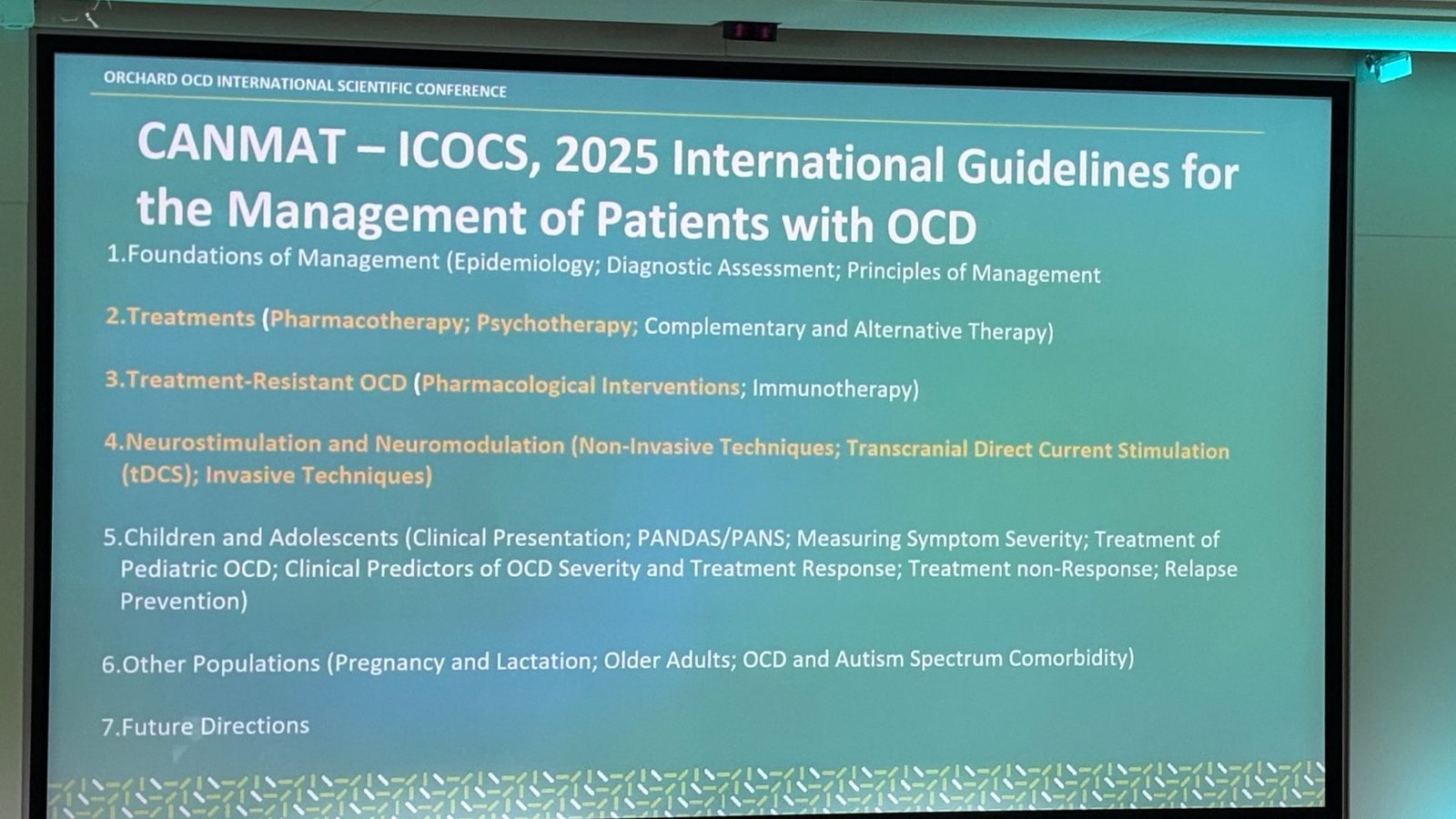
In my work as a BABCP-accredited CBT therapist specialising in OCD, I often meet people who have heard of ERP but still feel unsure about what evidence-based OCD treatment should actually look like in practice. I was introduced to the topic of the CANMAT/ICOCS 2025 international OCD treatment guidelines at the Orchard OCD Conference, and what struck me was not only the strength of the evidence, but how much the guidelines reinforce something I see clinically every week: OCD treatment has to be active, specific and carefully matched to the person’s compulsive loop (Van Ameringen et al., 2026).
The short answer is this: the 2025 CANMAT/ICOCS guidelines continue to recommend CBT with Exposure and Response Prevention and serotonin reuptake inhibitor medication as first-line treatments for obsessive-compulsive disorder (Van Ameringen et al., 2026). For many people, the right plan is not simply “therapy or medication”, but a thoughtful sequence based on severity, preference, risk, previous treatment response, comorbidity and access to specialist OCD care (NICE, 2005; Van Ameringen et al., 2026).
What are the CANMAT/ICOCS 2025 international OCD guidelines?
The CANMAT/ICOCS 2025 guidelines are international, evidence-based OCD management guidelines developed by the Canadian Network for Mood and Anxiety Treatments and the International College of Obsessive-Compulsive Spectrum Disorders. They review OCD diagnosis, psychological treatment, medication, treatment resistance, neurostimulation, children and adolescents, special populations and future directions (Van Ameringen et al., 2026).
A guideline is not a script. It is a map. The authors state that the recommendations are designed to support clinical judgement rather than replace it, which matters because OCD is not one single presentation (Van Ameringen et al., 2026).
OCD can involve contamination fears, checking, harm obsessions, sexual intrusive thoughts, religious or moral fears, symmetry rituals, relationship doubts, health anxiety, mental reviewing, reassurance-seeking, avoidance and many other patterns (American Psychiatric Association, 2022; Van Ameringen et al., 2026). A person with contamination OCD and a person with taboo intrusive thoughts may both meet diagnostic criteria for OCD, but the treatment plan needs to identify the exact obsession-compulsion cycle that keeps each person stuck.
The guidelines also highlight that OCD is common, impairing and often long-lasting. Lifetime prevalence is estimated at approximately 1.3% to 2.4%, and OCD is associated with reduced quality of life, functional impairment and increased burden for individuals and families (Van Ameringen et al., 2026). In plain English: OCD is common enough that clinicians should know how to recognise it, but complex enough that vague anxiety management is often not sufficient.
What is the first-line treatment for OCD in 2025?
The first-line treatments for OCD in 2025 are CBT with Exposure and Response Prevention and serotonin reuptake inhibitor medication. NICE guidance also recommends CBT, including ERP and SSRIs, as central treatment options for OCD, with treatment intensity guided by severity, impairment and previous response (NICE, 2005; Van Ameringen et al., 2026).
ERP stands for Exposure and Response Prevention. Exposure means deliberately approaching feared thoughts, images, sensations, situations or triggers. Response prevention means reducing the rituals, reassurance, checking, avoidance, rumination, neutralising or mental reviewing that usually follow the trigger (Reid et al., 2021; Van Ameringen et al., 2026).
This is one of the most misunderstood parts of OCD treatment. ERP is not about proving that the feared outcome will never happen. That can become another reassurance trap. Good ERP teaches the brain, through repeated practice, that you can experience uncertainty, anxiety, disgust, guilt or doubt without obeying OCD’s demand for a compulsion (Reid et al., 2021).
Medication can also be first-line. The CANMAT/ICOCS guidelines list serotonin reuptake inhibitors, including SSRIs, as first-line pharmacological treatments for OCD, and they emphasise the importance of an adequate treatment trial before deciding that medication has not helped (Van Ameringen et al., 2026). NHS guidance also explains that SSRIs are commonly used in OCD treatment and that it can take several weeks before the full benefit becomes clear (NHS, n.d.).
Is ERP still the gold-standard therapy for OCD?
Yes. ERP remains a central evidence-based OCD treatment, especially when it is delivered as part of structured CBT by a therapist who understands both visible compulsions and hidden mental rituals (NICE, 2005; Reid et al., 2021; Van Ameringen et al., 2026).
The phrase “gold standard” can sound intimidating. Some people hear it and think, “If I cannot do ERP perfectly, I have failed.” I do not see it that way. ERP is not a performance test. It is a learning process.
A common clinical problem is that exposures are designed around the obvious trigger, while the hidden response is missed. For example, a person with harm OCD may hold a kitchen knife as an exposure while silently reassuring themselves, “I know I would never do anything.” From the outside, it looks like ERP. From the inside, the person is still performing a reassurance ritual. The feared object is present, but the compulsive loop is still being fed.
This is why OCD therapy needs precise formulation. The therapist and client need to identify not only what the person fears, but what the person does next to reduce doubt, prevent danger, feel certain or feel “right” again.
The Map–Match–Move model: a practical way to understand OCD treatment
The Map–Match–Move model is a simple framework I use clinically to help people understand why OCD persists and what kind of treatment step may help next. It is not a replacement for formal assessment or therapy, but it can help you think more clearly about your own OCD cycle.
Map: What is the full OCD loop?
Mapping means identifying the trigger, the feared meaning, the emotional response, the compulsion and the short-term relief that keeps the cycle going. OCD is maintained not only by anxiety, but by the repeated attempt to remove uncertainty or prevent a feared outcome through compulsions (American Psychiatric Association, 2022; Van Ameringen et al., 2026).
A trigger might be a thought such as “What if I harm someone?”, a sensation such as feeling contaminated, a memory that feels morally unresolved, or a doubt about whether something was done correctly. The compulsion might be washing, checking, confessing, seeking reassurance, mentally reviewing, comparing feelings, avoiding people, repeating words, praying in a rigid way, or trying to replace a “bad” thought with a “good” one.
Match: Which intervention targets the maintaining factor?
Matching means choosing the treatment strategy that fits the maintaining behaviour. If avoidance is central, exposure may need to focus on approaching avoided situations. If rumination is the compulsion, response prevention must include learning to disengage from mental analysis. If family reassurance is maintaining OCD, treatment may need to address family accommodation (Van Ameringen et al., 2026).
This is where general advice often falls short. Telling someone with OCD to “just let the thought pass” can be unhelpful if the person does not know how to stop analysing the thought afterwards. The thought is not always the main problem. The mental work done after the thought is often the compulsion.
Move: What is the next useful step?
Moving means choosing the smallest behaviour that genuinely weakens the OCD cycle. This does not mean choosing the easiest step. It means choosing a step that is challenging enough to create new learning but realistic enough to repeat.
For one person, the move might be touching a feared surface and delaying washing. For another, it might be reading a triggering sentence without mentally neutralising it. For another, it might be answering reassurance-seeking with, “I am choosing not to solve this right now.”
Should I choose therapy, medication, or both?
The best starting point depends on severity, preference, previous response, risk, comorbidity and access to skilled ERP. The CANMAT/ICOCS guidelines state that both CBT-based psychotherapy and serotonin reuptake inhibitor medication are first-line options, and that treatment decisions should be collaborative (Van Ameringen et al., 2026).
For mild to moderate OCD, many people prefer starting with CBT including ERP, especially if they want to understand the OCD cycle and learn how to reduce compulsions directly (NICE, 2005; Reid et al., 2021). For moderate to severe OCD, medication can reduce symptom intensity and help the person engage more fully in ERP, and combined treatment can be appropriate when impairment is high (NICE, 2005; Van Ameringen et al., 2026).
Here is the clinical nuance. Preference matters, but OCD can distort preference. A person may say, “I do not want ERP,” when what they mean is, “OCD has convinced me I must avoid distress at all costs.” That does not mean a therapist should push aggressively. It means the decision needs careful discussion, psychoeducation and a graded plan that respects the person without obeying the disorder.
What if OCD treatment has not worked before?
If OCD treatment has not worked before, the next step is not to assume that you are untreatable. The first step is to review whether the previous treatment had the right target, dose, duration and level of specialist input (Van Ameringen et al., 2026).
The CANMAT/ICOCS guidelines describe several pathways after inadequate response. These include optimising medication, switching medication, adding CBT/ERP, increasing the intensity of CBT/ERP, considering augmentation strategies and referring to specialist services for more severe or persistent OCD (Van Ameringen et al., 2026).
In my clinical experience, “failed CBT” often means one of five things: the therapy focused on general anxiety rather than OCD-specific compulsions; the exposures were too random, too easy or too overwhelming; mental rituals were not identified; reassurance continued outside sessions; or the person stopped early because distress increased before new learning had time to consolidate.
None of this means blame. It means the treatment needs a better formulation.
An anonymised clinical example
A client once described having “done ERP” for intrusive thoughts, but felt worse afterwards. When we explored what had happened, the exposures involved reading feared words and imagining distressing scenarios. On paper, that sounded appropriate. But during every exposure, the client was silently checking their emotional reaction, scanning for signs of danger, reassuring themselves that the thought was “not really me”, and reviewing memories afterwards to prove they were safe.
The problem was not that ERP was the wrong treatment. The problem was that the response prevention had not reached the mental compulsions. Once therapy shifted from “Can I tolerate the image?” to “Can I stop solving what the image means?”, the work became more targeted. Progress was not instant, but the treatment finally started addressing the mechanism that kept OCD alive.
Are online OCD treatments effective?
Online CBT can be effective for OCD when it is structured, therapist-supported and includes ERP principles. The CANMAT/ICOCS guidelines identify internet-delivered CBT as a digital treatment option, while also noting that people with higher baseline severity may need more therapist involvement or more intensive care (Van Ameringen et al., 2026).
This is reassuring for people who cannot easily access a specialist locally. Online ERP can work well because OCD usually lives in your real environment: your bathroom, your kitchen, your phone, your inbox, your relationship, your bedtime routine. Video therapy can bring treatment closer to the actual compulsive patterns.
An app alone is not the same as specialist therapy. The guidelines caution that many mental health apps have limited direct evidence, raise privacy concerns and can struggle with engagement (Van Ameringen et al., 2026). For OCD, there is also a practical risk: a tool designed to help can become another checking or reassurance tool if it is used compulsively.
What do the 2025 guidelines say about children, adolescents and families?
For children and adolescents, CBT with ERP remains central, and family involvement is often important. The guidelines describe family-based CBT as an evidence-supported approach because parents and carers can unintentionally become part of the OCD cycle through reassurance, avoidance or accommodation (Van Ameringen et al., 2026).
Family accommodation means changing family routines to reduce the person’s OCD distress. It can include answering repeated reassurance questions, cleaning in a specific way, avoiding words, helping with rituals, checking on behalf of the person, or changing family activities around OCD rules (Van Ameringen et al., 2026).
Families usually do this out of love. OCD then uses that love as fuel.
A helpful family question is not, “How do we stop upsetting them?” but, “How do we support them without supporting OCD?” That shift is small, but clinically powerful.
What is treatment-resistant OCD?
Treatment-resistant OCD means symptoms remain significantly impairing despite adequate evidence-based treatment. The CANMAT/ICOCS guidelines discuss more intensive CBT/ERP, medication strategies, augmentation, neurostimulation and specialist services for people with severe or persistent OCD (Van Ameringen et al., 2026).
This label should be used carefully. Before calling OCD treatment-resistant, clinicians should ask whether previous ERP was truly delivered with response prevention, whether medication was taken for long enough at an appropriate dose, whether comorbidities were assessed, and whether risk was reviewed (NICE, 2005; Van Ameringen et al., 2026).
For a small group of people with severe, chronic and treatment-resistant OCD, specialist services may consider approaches such as transcranial magnetic stimulation, deep brain stimulation or neurosurgical options, but these are not ordinary first steps and require specialist assessment (Van Ameringen et al., 2026).
What should a good OCD assessment include?
A good OCD assessment should identify obsessions, compulsions, avoidance, insight, risk, impairment, comorbidity and family accommodation. It should also ask about hidden compulsions such as rumination, mental checking, reassurance-seeking, neutralising, confessing and reviewing (American Psychiatric Association, 2022; Van Ameringen et al., 2026).
This matters because OCD is often mislabelled as general anxiety, depression, trauma, psychosis, relationship problems, health anxiety or personality difficulty. Differential diagnosis is not an academic exercise. It changes treatment.
For example, intrusive thoughts in OCD are typically unwanted, distressing and followed by attempts to neutralise or undo them (American Psychiatric Association, 2022). In obsessive-compulsive personality disorder, the pattern is more about rigid perfectionism, order and control, rather than intrusive obsessions followed by compulsions (American Psychiatric Association, 2022). In psychosis, beliefs and experiences may involve different levels of conviction and may occur alongside symptoms such as hallucinations or disorganised thinking (American Psychiatric Association, 2022; Van Ameringen et al., 2026).
A careful assessment protects you from the wrong treatment.
What is the biggest practical message from the OCD management guidelines?
The biggest practical message is that OCD treatment should be active, specific and measurable. It should not become endless reassurance, vague talking therapy, or repeated analysis of whether the intrusive thought is “true” (NICE, 2005; Reid et al., 2021; Van Ameringen et al., 2026).
Here is the counterintuitive part: the aim is not to feel certain before you act. In OCD recovery, you often act first in line with your values, then allow your nervous system to catch up. Waiting until you feel certain usually means waiting under OCD’s rules.
A useful question is:
What would I do next if I did not have to solve this thought first?
That question does not cure OCD. But it points treatment in the right direction.
FAQ
Are the 2025 international OCD guidelines different from NICE guidance?
The CANMAT/ICOCS 2025 guidelines are newer and broader in scope, but they are consistent with NICE guidance in recommending CBT, including ERP and SSRIs, as central evidence-based treatments for OCD (NICE, 2005; Van Ameringen et al., 2026). NICE remains especially important for UK care pathways.
Is ERP better than medication for OCD?
ERP and serotonin reuptake inhibitor medication are both evidence-based first-line treatments for OCD (Skapinakis et al., 2021; Van Ameringen et al., 2026). The best option depends on severity, preference, previous treatment response, tolerability, risk and access to specialist ERP.
How long should OCD treatment take to work?
Many people need several weeks before a clear improvement appears. The CANMAT/ICOCS guidelines describe around 12 weeks as an important period for evaluating response when treatment adherence is adequate (Van Ameringen et al., 2026). NHS guidance also notes that SSRIs may take up to 12 weeks before benefit is noticed (NHS, n.d.).
Can OCD be treated online?
Yes, online CBT can help OCD when it is structured, therapist-supported and includes ERP principles. The 2025 guidelines support internet-delivered CBT as a digital option, while noting that people with more severe symptoms may need more intensive therapist involvement (Van Ameringen et al., 2026).
What if ERP feels too frightening?
ERP should be challenging, but it should not be careless, humiliating or overwhelming. A skilled therapist can help you build a graded plan, identify hidden compulsions and work at a pace that supports learning rather than avoidance (Reid et al., 2021; Van Ameringen et al., 2026).
When to seek help
Please seek professional help if OCD symptoms are taking up significant time, causing distress, or affecting work, study, relationships, sleep, parenting, faith, health or daily functioning. You can speak with your GP, search for a BABCP-accredited CBT therapist, or contact OCD-UK for information and support.
If you are experiencing thoughts of harming yourself, feel unable to stay safe, or are in immediate danger, contact emergency services, NHS 111, your local crisis team, or go to A&E. OCD can be associated with increased suicidal thoughts and suicide attempts, so risk should always be taken seriously and assessed directly (Van Ameringen et al., 2026).
Author bio
Federico Ferrarese is a BABCP-accredited Cognitive Behavioural Therapist and Chartered Psychologist specialising in OCD and anxiety disorders. He provides evidence-based CBT and ERP-informed treatment for adults experiencing obsessive-compulsive disorder, intrusive thoughts, compulsions, rumination, reassurance-seeking and related anxiety difficulties.
Professional registration: BABCP-accredited CBT Therapist and BPS Chartered Psychologist.
Registration number: 00001005090
About Federico: https://federicoferrarese.co.uk/about/
References:
American Psychiatric Association. (2022). Diagnostic and statistical manual of mental disorders (5th ed., text rev.). American Psychiatric Association Publishing.
National Health Service. (n.d.). Treatment: Obsessive compulsive disorder (OCD). https://www.nhs.uk/mental-health/conditions/obsessive-compulsive-disorder-ocd/treatment/
National Institute for Health and Care Excellence. (2005). Obsessive-compulsive disorder and body dysmorphic disorder: Treatment (Clinical guideline CG31). https://www.nice.org.uk/guidance/cg31
Reid, J. E., Laws, K. R., Drummond, L., Vismara, M., Grancini, B., Mpavaenda, D. N., & Fineberg, N. A. (2021). Cognitive behavioural therapy with exposure and response prevention in the treatment of obsessive-compulsive disorder: A systematic review and meta-analysis of randomised controlled trials. Comprehensive Psychiatry, 106, 152223. https://doi.org/10.1016/j.comppsych.2021.152223
Skapinakis, P., Caldwell, D. M., Hollingworth, W., Bryden, P., Fineberg, N. A., Salkovskis, P., Welton, N. J., Baxter, H., Kessler, D., Churchill, R., & Lewis, G. (2021). Pharmacological and psychotherapeutic interventions for management of obsessive-compulsive disorder in adults: A systematic review and network meta-analysis. Focus, 19(4), 457–467. https://doi.org/10.1176/appi.focus.19402
Van Ameringen, M., Fineberg, N. A., Ravindran, A., Arnold, P. D., Beaulieu, S., Brakoulias, V., Brietzke, E., Dowlati, Y., Drummond, L. M., Ferretti, C. J., Feusner, J. D., Freire, R. C. R., Frey, B. N., Gardiner, S., Geller, D. A., Giacobbe, P., Goldman Bergmann, C., Grassi, G., Greenberg, E., Hollander, E., & Dell’Osso, B. M. (2026). Canadian Network for Mood and Anxiety Treatments (CANMAT) and International College of Obsessive-Compulsive Spectrum Disorders (ICOCS) 2025 international guidelines for the management of patients with obsessive-compulsive disorder. Journal of Psychiatric Research, 199, 404–488. https://doi.org/10.1016/j.jpsychires.2025.12.039




0 Comments