
Clinical disclaimer
This article is for informational purposes only and does not constitute clinical advice, diagnosis, or treatment. If you are struggling, please speak to your GP or a registered therapist.
Quick summary
- OCD vs health anxiety is one of the most confused distinctions in mental health — the two share fears, checking, and reassurance-seeking, but they are classified as separate conditions.
- Health anxiety (now most often diagnosed as illness anxiety disorder) sits in the somatic-symptom family; OCD sits in the obsessive-compulsive family (American Psychiatric Association, 2022).
- The content of the fear (illness, death, symptoms) can’t tell you which condition you have. The mechanism — what triggers it and what the rituals are trying to achieve — usually can.
- Both respond to cognitive behavioural therapy, but the most effective approach for OCD is exposure and response prevention (ERP), which works in the opposite direction to the reassurance cycle most people fall into (National Institute for Health and Care Excellence, 2005; Olatunji et al., 2013).
- If your worry about your health has taken over your time, your relationships, or your bank balance, that’s reason enough to get assessed — regardless of the label.
What you won’t find elsewhere
Most articles on this topic give you a side-by-side symptom table and leave you to self-diagnose. I’ve done something different. Below you’ll find the three questions I actually use in the consulting room to separate health anxiety from health-themed OCD — a framework built around mechanism, not symptoms — plus a short decision aid you can apply to your own worry today. You’ll also find the one point almost every other page gets wrong: that the topic of your fear can diagnose you. It can’t, and believing it can will send you looking for the wrong help.
OCD vs Health Anxiety: Same Fear, Different Condition?
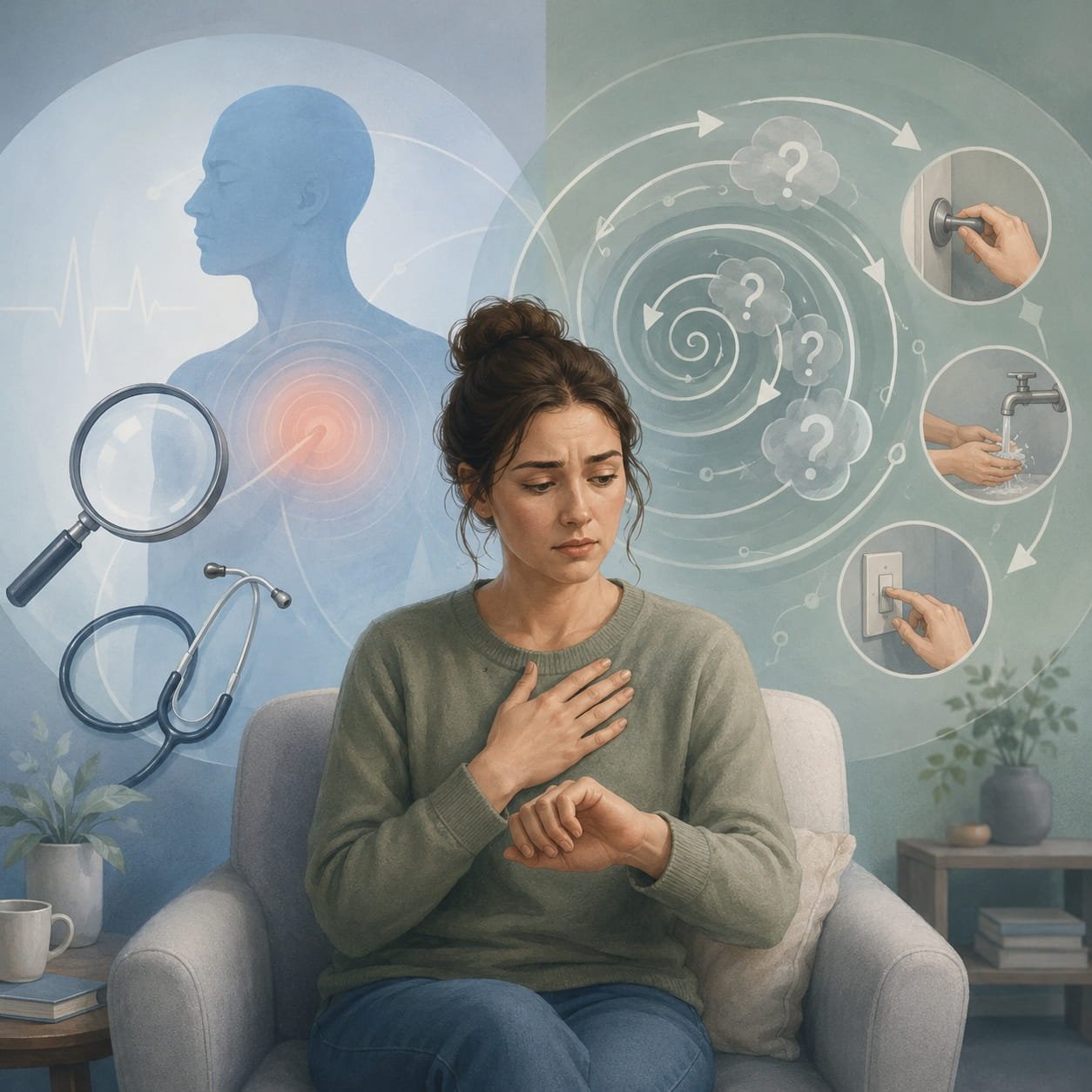
You feel a twinge in your chest. Within minutes, you’re online, typing symptoms into a search bar, reading a forum thread at 1 a.m., pressing two fingers to your wrist to count your pulse again. Is this health anxiety? Is it OCD? And does the difference even matter?
It does — because the wrong label can point you toward the wrong treatment. In my work with people who have OCD and health-related fears, I’ve sat with hundreds of clients who’d spent years being told to “stop Googling and relax,” when what they actually needed was a structured, evidence-based approach. OCD vs health anxiety is a distinction worth getting right, and this is the page where I’ll help you get it right.
A quick, honest answer before we go deeper: health anxiety and OCD overlap so heavily that even experienced clinicians sometimes disagree about where one ends and the other begins. They are separate diagnoses with different homes in the diagnostic manual, but they share the same engine. Understanding that the engine is what helps you recover.
What’s the difference between OCD and health anxiety?
Health anxiety is a persistent preoccupation with the idea that you have, or will develop, a serious illness. OCD is a condition in which unwanted intrusive thoughts (obsessions) drive repetitive behaviours or mental acts (compulsions) aimed at reducing distress.
The simplest way to hold the difference: health anxiety is defined by what you fear (illness), while OCD is defined by how the fear behaves (the obsession–compulsion loop), regardless of topic. When OCD latches onto health, the two can look almost identical from the outside — same checking, same reassurance-seeking, same midnight searches. The difference lies in the structure underneath.
Is health anxiety a type of OCD?
No — but they are close cousins. In the current diagnostic system, illness anxiety disorder (the formal term that replaced “hypochondriasis”) is classified among the somatic symptom and related disorders, while OCD has its own chapter, the obsessive-compulsive and related disorders (American Psychiatric Association, 2022).
That said, the wall between them is thinner than the manual suggests. Research using the Short Health Anxiety Inventory found that meaningful levels of health anxiety run through several anxiety presentations, and that severe health anxiety shares core cognitive features with OCD — most notably catastrophic misinterpretation of normal bodily sensations and the urge to neutralise that fear through reassurance (Abramowitz et al., 2007). So health anxiety is not a subtype of OCD, but health can become the content of someone’s OCD. When that happens, clinicians sometimes describe it informally as health-related OCD or OCD about health. The naming matters less than spotting the mechanism.
How common is health anxiety, and how does it relate to OCD?
Health anxiety is common, and most cases never reach a mental-health clinic. Drawing on the older hypochondriasis research it grew from, the diagnostic manual estimates a community prevalence of roughly 1.3–10% over one to two years, rising to 3–8% among people attending medical outpatient settings (American Psychiatric Association, 2022). OCD, for comparison, affects an estimated 2–3% of adults (Olatunji et al., 2013).
Here’s the practical link. When the diagnostic categories were revised, most people who would once have been called “hypochondriac” were re-sorted: those whose distress centred on actual physical symptoms moved into somatic symptom disorder, while those whose distress centred on the fear of illness itself — with few or no real symptoms — became illness anxiety disorder (Newby et al., 2017). It’s that second group whose experience overlaps most with OCD, because their suffering is driven by intrusive “what if I’m ill?” thoughts rather than by the body itself.
Three questions I use to tell health anxiety from health-related OCD
There’s no symptom checklist that cleanly separates these two, so I stopped relying on one years ago. Instead, I listen for the mechanism. These are the three questions I work through with clients. Think of them as a clinical compass, not a diagnostic test.
1. Where does the fear start — in the body, or in the mind?
Health anxiety usually starts in the body. A real sensation — a headache, a skipped heartbeat, a new mole — gets noticed and then catastrophically misread. The thought follows the feeling.
Health-related OCD more often runs the other way. An intrusive thought or image arrives first (“what if that lump is cancer?”, “what if I’ve already passed something on?”), sometimes with no bodily trigger at all. The feeling follows the thought. If your fear can fire up out of nowhere, on a day you feel physically fine, that pattern leans towards OCD.
2. Does the fear stay put, or does it mutate?
Health anxiety tends to circle a believable target: a specific disease, a specific organ, a specific outcome. There’s often a quiet conviction underneath — I really do think something is wrong.
OCD doubt behaves differently. It branches and shape-shifts. Reassure it about your heart, and it moves to your brain; settle the brain, and it asks whether you contaminated your child, or whether a fleeting thought somehow caused harm. The hallmark isn’t the belief that you’re ill — it’s the unbearable intolerance of not being certain. If your fear keeps escaping every answer and jumping to a new “what if,” that’s a strong OCD signal.
3. What is the ritual actually trying to buy?
Both conditions produce checking, reassurance-seeking, and compulsive Googling of symptoms. But ask what the behaviour is for. In health anxiety, the goal is usually to establish that you’re safe and healthy right now. In OCD, the goal is more often to extinguish the intrusive thought or reach a feeling of certainty or “just-rightness” — and the relief, if it comes, is briefer, and the bar for “enough checking” keeps rising.
A composite illustration. A client came to me convinced she had a neurological disease. She’d had every scan; all were clear. What gave it away as OCD rather than straightforward health anxiety wasn’t the topic — it was that each reassuring result bought her only hours of calm before the doubt mutated (“but what if they missed it / what if it’s a different illness?”), and that her real terror was less being ill and more not being able to know for sure. The clear scans, paradoxically, fed the loop.
The honest, slightly uncomfortable takeaway: the subject of your fear cannot diagnose you. Two people can both fear cancer — one has health anxiety, one has OCD — and the difference is entirely in the machinery, not the worry. This is why self-diagnosing from a symptom list so often misfires.
Why checking and Googling look different in OCD vs health anxiety
Checking, reassurance-seeking, and symptom-Googling are compulsions in both conditions — but they serve subtly different masters, which is why generic “just stop checking” advice rarely sticks.
In health anxiety, the checking is a search for proof of safety. In OCD, it’s more often an attempt to neutralise an intrusive thought or to manufacture certainty. Both are powered by the same fuel: the short-term relief that reassurance brings, which trains your brain to come back for more. That mechanism — and how to step out of it — is its own subject, and I cover it in depth elsewhere; if reassurance is the behaviour that’s running your life, start with how to break the reassurance-seeking cycle. If it’s the thoughts themselves that frighten you, my guide to understanding intrusive thoughts is the better home for that question. I’ll keep this section deliberately short, because the differential — not the treatment of checking itself — is what this page is about.
What about somatic OCD and contamination OCD?
It’s worth clearing up two presentations that people confuse with health anxiety. They are not the same thing.
Contamination OCD centres on a fear of germs, dirt, or disease transmission, with compulsions like washing, cleaning, and avoidance. The dread is usually about catching or spreading illness, not about a disease you believe is already silently growing inside you, which is where it parts ways from classic health anxiety.
Somatic (or sensorimotor) OCD is different again: here the obsession fixes on an automatic bodily process — your breathing, blinking, swallowing, or heartbeat — and the fear is of being unable to stop noticing it, rather than of being ill. (I treat this presentation in a dedicated piece; see my article on somatic/sensorimotor OCD) Illness anxiety disorder, by contrast, is about the meaning you attach to sensations — the conviction or dread that they signal serious disease.
How is treatment different? ERP versus the reassurance-driven GP cycle
The single biggest treatment difference isn’t the therapy model — it’s direction of travel. Most people with health fears are already running a reassurance loop: notice symptom, seek certainty, feel briefly better, repeat. Effective treatment for OCD deliberately reverses that loop.
For OCD, the first-line psychological treatment recommended in the UK is cognitive behavioural therapy that includes exposure and response prevention, or ERP (National Institute for Health and Care Excellence, 2005). ERP involves gradually facing the feared thought or situation while resisting the compulsion — not checking, not Googling, not seeking reassurance — so your nervous system learns that the anxiety subsides on its own and the feared catastrophe doesn’t depend on the ritual. A meta-analysis of sixteen randomised controlled trials found CBT for OCD produced a large effect on symptoms compared with control conditions (Hedges’ g = 1.39 at post-treatment), with a smaller but meaningful effect maintained at follow-up (Olatunji et al., 2013). I want to be precise here: that’s an effect size from the research, not a promise that any individual will be “cured” or hit a particular recovery percentage.
This is the opposite of what usually happens in a reassurance-driven GP cycle, where each new symptom prompts another appointment, another test, another moment of relief that fades within days. Those visits are sometimes necessary — but when they’ve become part of the compulsion, more reassurance tends to deepen the groove rather than fill it. Health anxiety responds to cognitive behavioural approaches too, often with a similar emphasis on dropping safety behaviours and reducing reassurance-seeking.
If your next question is “so how do I actually get assessed for this?”, that’s exactly the right question — and I’ve written a dedicated walkthrough. Start with my guide to OCD assessment and diagnosis, which covers what a proper assessment involves and how to access one.
Key takeaways: a quick decision aid
Run your own worry through these five checks. None is diagnostic on its own, but together they point you in a direction:
- Origin — Does the fear usually start with a thought (leans OCD) or a bodily sensation (leans health anxiety)?
- Movement — Does it stay on one feared illness, or does it branch and mutate when reassured (leans OCD)?
- Core dread — Is your deepest fear being ill, or not being able to be certain (the second leans toward OCD)?
- Ritual payoff — Does reassurance settle you for a while, or does relief evaporate almost instantly and the checking escalate (leans OCD)?
- Cost — Is the worry eating your time, money, sleep, or relationships? (If yes, seek help regardless of which label fits.)
FAQ
Can health anxiety actually be OCD? Sometimes, yes. Health anxiety and OCD are separate diagnoses, but health can become the theme of someone’s OCD. When intrusive “what if I’m ill?” thoughts drive compulsive checking and reassurance-seeking, and the fear branches and mutates rather than settling, the presentation fits OCD even though the topic is health (Abramowitz et al., 2007).
Is illness anxiety disorder the same as OCD? No. Illness anxiety disorder is classified among the somatic symptom and related disorders, while OCD has its own diagnostic chapter (American Psychiatric Association, 2022). They share features — intrusive fears, reassurance-seeking, checking — but they are distinct conditions, and only a qualified clinician can diagnose either.
How do I stop compulsively Googling my symptoms? Compulsive symptom-Googling is a reassurance behaviour, and the more you do it, the stronger the urge becomes. The evidence-based approach is to reduce and then drop the behaviour rather than do it “better” — ideally with support, because doing it alone is hard. I cover the mechanism and practical steps in my dedicated piece on breaking the reassurance-seeking cycle.
Does CBT work for health anxiety and OCD? Cognitive behavioural therapy is the recommended psychological treatment for both, and for OCD specifically, the manual recommends CBT that includes exposure and response prevention (National Institute for Health and Care Excellence, 2005). Research shows CBT produces a large effect on OCD symptoms (Olatunji et al., 2013), though outcomes vary between individuals.
Will reassurance from my GP make health anxiety worse? Not always — but when reassurance-seeking has become compulsive, repeated reassurance tends to relieve anxiety only briefly and then strengthen the urge to seek it again. The aim in treatment is to gradually reduce that dependence, not to abandon genuinely needed medical care.
When to seek professional help
If your fear of illness is taking up significant time each day, driving repeated GP visits or tests, fuelling hours of symptom-searching, or affecting your sleep, work, money, or relationships, it’s worth getting professional support — and you don’t need to be “sure” it’s OCD or health anxiety first. That’s what assessment is for.
Good first steps:
- Speak to your GP. They can rule out physical causes and refer you on. (In the UK, you can also self-refer to NHS Talking Therapies for assessment.)
- Find an accredited therapist. The BABCP register lets you search for accredited CBT therapists, including those who specialise in OCD
- If you are in crisis or thinking about harming yourself, contact your GP, NHS 111, or the Samaritans on 116 123.
About the author
Federico Ferrarese is a BABCP-accredited Cognitive Behavioural Psychotherapist and BPS Chartered Psychologist (registration no. 00001005090) with an MSc in Applied Neuroscience. He specialises in the treatment of OCD using exposure and response prevention (ERP) and runs an online private practice offering sessions in English and Italian, based near Edinburgh. Learn more on the About page.
References
References:
Abramowitz, J. S., Olatunji, B. O., & Deacon, B. J. (2007). Health anxiety, hypochondriasis, and the anxiety disorders. Behavior Therapy, 38(1), 86–94. https://doi.org/10.1016/j.beth.2006.05.001
American Psychiatric Association. (2022). Diagnostic and statistical manual of mental disorders (5th ed., text rev.). https://doi.org/10.1176/appi.books.9780890425787
National Institute for Health and Care Excellence. (2005). Obsessive-compulsive disorder and body dysmorphic disorder: Treatment (NICE guideline CG31). https://www.nice.org.uk/guidance/cg31
Newby, J. M., Hobbs, M. J., Mahoney, A. E. J., Wong, S. K., & Andrews, G. (2017). DSM-5 illness anxiety disorder and somatic symptom disorder: Comorbidity, correlates, and overlap with DSM-IV hypochondriasis. Journal of Psychosomatic Research, 101, 31–37. https://doi.org/10.1016/j.jpsychores.2017.07.010
Olatunji, B. O., Davis, M. L., Powers, M. B., & Smits, J. A. J. (2013). Cognitive-behavioral therapy for obsessive–compulsive disorder: A meta-analysis of treatment outcome and moderators. Journal of Psychiatric Research, 47(1), 33–41. https://doi.org/10.1016/j.jpsychires.2012.08.020




0 Comments