
Shame and OCD: Why Taboo Subtypes Are the Hardest to Treat
Clinical Disclaimer
This article is for informational purposes only and does not constitute clinical advice or a substitute for assessment by a qualified mental health professional.
Understanding the connection between Shame and OCD can be crucial for effective therapy.
-
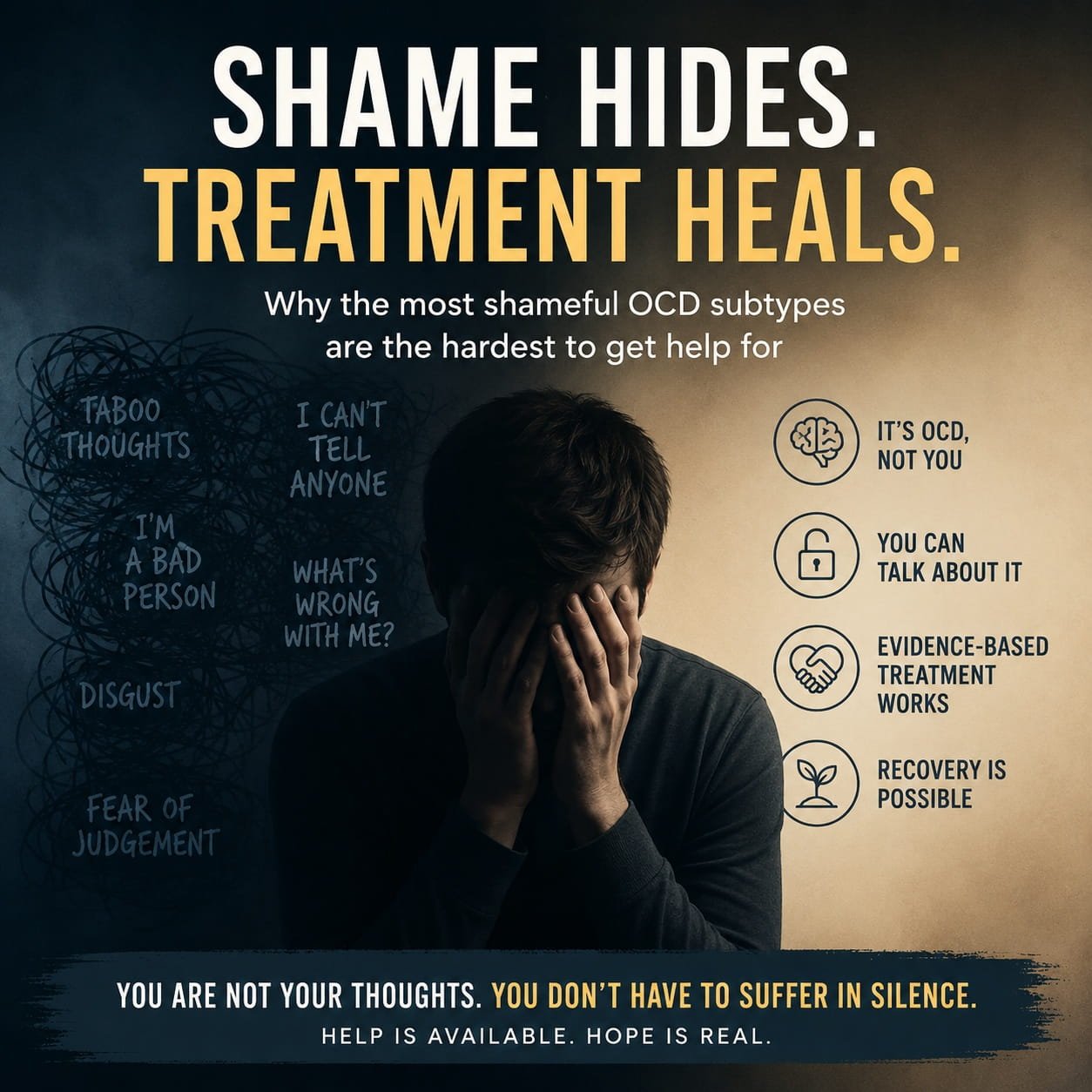
- Shame and OCD are tightly linked: the more taboo the intrusive thought, the more likely a person is to hide it from clinicians, sometimes for over a decade.
- The “shameful” subtypes — paedophilia-themed OCD (POCD), sexual orientation OCD (SO-OCD), harm OCD, and religious scrupulosity — share one feature: the content is ego-dystonic, meaning it horrifies the person experiencing it.
The discussion surrounding Shame and OCD often brings to light deeply held fears and beliefs.
- Concealment is itself a compulsion. The longer it continues, the more it strengthens the OCD cycle.
- Evidence-based treatment — Cognitive Behavioural Therapy with Exposure and Response Prevention (CBT/ERP) — works for these subtypes, but only when the content is named and treated directly.
- If a previous therapist has reassured you, avoided the content, or misinterpreted it, that is a treatment issue — not a sign that you are untreatable.
What You Won’t Find Elsewhere
This article provides insight into the complex relationship between Shame and OCD, offering a clinical framework and practical tips for those affected.
The Challenges of Addressing Shame and OCD in Therapeutic Settings
In my work with OCD clients over the past several years as a BABCP-accredited CBT therapist, the pattern I see most often is not that people struggle to access treatment — it’s that they struggle to say the thing they actually need help with. The shame attached to certain OCD subtypes is so heavy that many people sit in assessment rooms for years, describing a sanitised version of their distress while the real obsession stays buried.
Many clients feel shame around their Shame and OCD symptoms, which can hinder their recovery process.
This article is for anyone who has googled their intrusive thoughts at 2 am and closed the tab feeling worse. I want to explain, plainly, why shame and OCD form one of the most stubborn loops in clinical practice, why your most “unspeakable” thoughts are almost certainly the most treatable, and what a first conversation with a therapist can actually look like.
Exploring the Role of Shame and OCD in Mental Health
Shame in OCD is the experience of believing that the content of an intrusive thought reveals something dangerous, evil, or unacceptable about who you are. It is distinct from guilt, which is the discomfort of having done something wrong. Shame says: I am wrong.
Research has consistently linked shame to OCD severity and treatment delay. Weingarden and Renshaw (2015) reviewed the literature on shame across obsessive-compulsive and related disorders and concluded that shame is both a consequence of having intrusive thoughts and an active maintaining factor in the disorder. In a study of shame across OCD symptom dimensions, Wetterneck et al. (2014) found that shame proneness was particularly elevated in clients with unacceptable sexual and aggressive obsessions — the subtypes most people never voluntarily disclose.
Shame and OCD intertwine, making it essential for therapists to address this dynamic in treatment.
When you cannot name the obsession, you cannot do the therapeutic work that disarms it. That is the engine of the problem.
Identifying the Most Shameful OCD Subtypes
The subtypes most likely to be concealed are those involving taboo content: themes the person finds morally abhorrent and which directly contradict their values. In my caseload, the clusters that come up most frequently are:
Paedophilia-themed OCD (POCD)
Intrusive thoughts, images, or urges involving sexual content with children. The person experiences profound revulsion and often takes drastic measures to avoid children — including their own. Despite the horror of the content, no research evidence links POCD to actual offending behaviour; the defining feature is precisely the opposite: the thoughts are ego-dystonic and deeply unwanted (Bruce et al., 2018).
Sexual Orientation OCD (SO-OCD)
Persistent doubt about one’s sexual orientation, often accompanied by compulsive “testing” — looking at people, monitoring arousal, replaying past experiences. This is not the same as questioning one’s identity. The hallmark is that the doubt is unwanted and accompanied by distress, not curiosity (Williams et al., 2014).
Harm OCD
Intrusive thoughts about harming others — often loved ones, often in graphic detail. Common compulsions include hiding knives, avoiding being alone with children or partners, and seeking reassurance that one is “not a violent person.”
Religious Scrupulosity
Obsessions about having sinned, blasphemed, or offended a religious figure. Compulsions often involve praying, confessing, or seeking reassurance from clergy.
Relationship OCD with Taboo Content
Relationship OCD often intersects with themes of Shame and OCD, complicating personal dynamics.
All of these subtypes share the same underlying mechanism: an unwanted intrusive thought collides with the person’s deepest values, and the brain treats that collision as a threat that must be neutralised (Rachman, 1997).
Recognising the role of Shame and OCD is vital for the therapeutic process.
Why Does OCD Pick the Things You’d Never Choose?
OCD is not a random selection of thoughts. It targets what you care about most. This is one of the most misunderstood aspects of the disorder, and even experienced clinicians sometimes get it wrong.
If you are someone who would be devastated by the idea of harming a child, your OCD will hand you thoughts about harming children. If your faith is the centre of your life, OCD will offer you blasphemous images during prayer. The intensity of the disgust you feel is not evidence that the thought is meaningful — it is evidence that the thought is threatening to something you value. That threat is precisely what makes the thought sticky.
Salkovskis’s cognitive model of OCD describes this clearly: it is not the intrusion itself that causes the disorder, but the appraisal the person attaches to it (Salkovskis, 1985). Most people have intrusive thoughts. People with OCD interpret them as meaningful, dangerous, or indicative of character.
The Shame–Concealment Loop: A Framework From My Clinical Practice
Clients often describe their experiences with Shame and OCD as isolating and distressing.
Here is the pattern I see in nearly every client who has waited years before disclosing a taboo subtype. I call it the Shame–Concealment Loop:
- Intrusion. A thought appears that the person finds morally abhorrent.
- Appraisal. The person concludes the thought means something terrible about them.
- Shame. Shame floods the system. The thought is now evidence of badness.
- Concealment. The person hides the thought — from partners, friends, GPs, even therapists.
- Compulsions in private. Mental review, reassurance-seeking (often via Google), and avoidance behaviours grow unchecked.
- Diagnostic drift. Without naming the actual obsession, treatment focuses on surface symptoms (anxiety, depression, “stress”).
- Symptoms worsen. Shame deepens. The person concludes they are uniquely broken.
- Loop tightens.
The point of this framework is that the loop has only one exit: step four. Concealment is the link in the chain that you can break with help. Everything else flows from it.
The relationship between Shame and OCD can create a cycle that complicates treatment.
García-Soriano et al. (2014) reviewed factors associated with delayed help-seeking in OCD and identified shame, fear of being judged, and symptom content as major barriers. The average delay between OCD symptom onset and accessing appropriate treatment runs to many years in published samples (García-Soriano et al., 2014).
Why Therapists Sometimes Make This Worse
This is hard to admit, but it matters. Not every therapist is trained in OCD, and a clinician who is unfamiliar with taboo subtypes can unintentionally entrench the problem in two ways:
They misdiagnose. Glazier et al. (2013) found that mental health professionals frequently misidentify OCD symptoms, particularly those involving sexual, aggressive, or religious obsessions. Clients reporting POCD or harm OCD are sometimes assessed as having a personality disorder, a paraphilic interest, or risk concerns — none of which describe OCD accurately.
They reassure. A well-meaning therapist who responds to “I have thoughts about harming my baby” with “You would never do that, you’re a loving parent” has just delivered a compulsion in clinical packaging. Reassurance reduces anxiety for a moment and strengthens the obsessional cycle (National Institute for Health and Care Excellence, 2005).
Therapists must be aware of how Shame and OCD can manifest in their clients’ lives.
If this has happened to you, it is not a sign that therapy doesn’t work for your subtype. It is a sign that you need a clinician trained specifically in CBT with ERP for OCD.
A Case Vignette (Anonymised, Composite Details)
A client I’ll call M came to me after seven years of weekly therapy for “anxiety.” She was a primary school teacher and a mother. In our third session, she told me she had been having intrusive sexual thoughts about children in her class since shortly after qualifying. She had never said this aloud. Two previous therapists had focused on her perfectionism and her difficult childhood. She had spent the seven years convinced that she was concealing a secret that, if known, would end her career and her marriage.
We named the obsession in the room. I told her what I’m telling you here: the thoughts are ego-dystonic, the disgust is the diagnostic feature, and the appropriate treatment is ERP. Within four months of beginning structured exposure work — including, eventually, sitting with the thoughts while at school rather than mentally arguing with them — her compulsive avoidance had collapsed, and the intrusive thoughts, while not absent, had lost their grip.
What changed was not the content of her mind. What changed was that the content was no longer a secret.
What Treatment Actually Looks Like
Understanding Shame and OCD is necessary for successful intervention and support.
For OCD across subtypes, the NICE-recommended psychological intervention is CBT incorporating Exposure and Response Prevention (National Institute for Health and Care Excellence, 2005). The principle of ERP is simple to describe and demanding to do: you deliberately encounter the trigger for your obsession, and you decline to perform the compulsion that usually follows.
For taboo subtypes, exposure rarely involves doing anything externally dramatic. Most of the work is internal — sitting with the thought, declining to mentally review your history, declining to monitor your body for signs of arousal or violent intent, declining to seek reassurance from your partner or Google.
Meta-analytic evidence supports CBT/ERP as effective for OCD, with response rates of approximately 60–80% reported across randomised controlled trials, though outcomes vary by symptom dimension and treatment adherence (Olatunji et al., 2013).
A First Disclosure Script You Can Use
If you have never said your obsession aloud, the first time is the hardest. Here is the wording I have given to clients to bring into an initial assessment. You do not need to describe the content in detail. You need to flag that there is content.
“I have intrusive thoughts that I find very distressing and that I have not been able to talk about before. The content is taboo and I am afraid of how you will respond. I would like to discuss whether what I’m experiencing fits with OCD before I describe the thoughts in detail. Can we approach it that way?”
A clinician trained in OCD will recognise this immediately and will respond by walking you through the structure of OCD, not by asking you to spell out the content before you are ready.
Clients often feel that their Shame and OCD are too taboo to share openly.
Quick Summary
OCD targets the thoughts you find most threatening to your values. Shame keeps those thoughts hidden, and concealment is the single most powerful maintaining factor in the cycle. Evidence-based treatment exists, works, and begins with naming the obsession in a room where the response will be clinical rather than horrified.
Common Questions About Shame and OCD
Why does OCD give me thoughts that go against everything I believe?
OCD attaches to your values. The thoughts feel unbearable precisely because they contradict who you are, and that contradiction is what your brain registers as a threat worth obsessing over (Rachman, 1997).
Are intrusive thoughts common in people without OCD?
Yes. Research suggests that the vast majority of the general population experience unwanted intrusive thoughts at some point, often with content similar to clinical obsessions. The difference in OCD is not the thought but the meaning attached to it and the compulsions that follow (Radomsky et al., 2014).
The stigma surrounding Shame and OCD can make seeking help even harder.
Will I be reported if I tell a therapist about violent or sexually intrusive thoughts?
A clinician trained in OCD understands the difference between an ego-dystonic intrusion and a stated intention. Disclosure of OCD-type intrusive thoughts, in the context of distress and the absence of intent, does not typically meet a safeguarding threshold. If you are worried, you can ask the therapist to explain their assessment process at the start of the session.
How long does treatment for shameful OCD subtypes usually take?
Treatment durations for Shame and OCD subtypes can vary, but structured CBT remains the gold standard.
Many people do not realise how common Shame and OCD can be.
What if I’ve tried therapy before and it didn’t help?
Generic counselling or talking therapy is often ineffective for OCD and can sometimes reinforce it through reassurance. If previous therapy did not include explicit ERP work targeting your actual obsessions, you have not yet had an adequate trial of OCD-specific treatment.
When to Seek Professional Help
Recognising signs of Shame and OCD early can lead to more effective treatment.
If intrusive thoughts are interfering with your work, relationships, or sense of self — or if you have been concealing them for months or years — it is time to speak to someone trained in OCD specifically. Useful starting points in the UK include:
- Your GP, who can refer you into NHS Talking Therapies for CBT.
- The BABCP therapist finder at cbtregisteruk.com, which lists accredited CBT therapists with declared specialisms.
- In a crisis, the Samaritans (116 123) are available 24 hours a day.
About the Author
As a therapist, I often encounter clients grappling with their Shame and OCD.
As an expert in the field, I am dedicated to understanding the complexities of Shame and OCD.
References:
Bruce, S. L., Ching, T. H. W., & Williams, M. T. (2018). Pedophilia-themed obsessive-compulsive disorder: Assessment, differential diagnosis, and treatment with exposure and response prevention. Archives of Sexual Behavior, 47(2), 389–402.
García-Soriano, G., Rufer, M., Delsignore, A., & Weidt, S. (2014). Factors associated with non-treatment or delayed treatment seeking in OCD sufferers: A review of the literature. Psychiatry Research, 220(1–2), 1–10.
Glazier, K., Calixte, R. M., Rothschild, R., & Pinto, A. (2013). High rates of OCD symptom misidentification by mental health professionals. Annals of Clinical Psychiatry, 25(3), 201–209.
National Institute for Health and Care Excellence. (2005). Obsessive-compulsive disorder and body dysmorphic disorder: Treatment (NICE Clinical Guideline CG31). https://www.nice.org.uk/guidance/cg31
Olatunji, B. O., Davis, M. L., Powers, M. B., & Smits, J. A. J. (2013). Cognitive-behavioral therapy for obsessive-compulsive disorder: A meta-analysis of treatment outcome and moderators. Journal of Psychiatric Research, 47(1), 33–41.
Rachman, S. (1997). A cognitive theory of obsessions. Behaviour Research and Therapy, 35(9), 793–802.
Radomsky, A. S., Alcolado, G. M., Abramowitz, J. S., Alonso, P., Belloch, A., Bouvard, M., Clark, D. A., Coles, M. E., Doron, G., Fernández-Álvarez, H., Garcia-Soriano, G., Ghisi, M., Gomez, B., Inozu, M., Moulding, R., Shams, G., Sica, C., Simos, G., & Wong, W. (2014). Part 1—You can run but you can’t hide: Intrusive thoughts on six continents. Journal of Obsessive-Compulsive and Related Disorders, 3(3), 269–279.
Salkovskis, P. M. (1985). Obsessional-compulsive problems: A cognitive-behavioural analysis. Behaviour Research and Therapy, 23(5), 571–583.
Weingarden, H., & Renshaw, K. D. (2015). Shame in the obsessive compulsive related disorders: A conceptual review. Journal of Affective Disorders, 171, 74–84.
Wetterneck, C. T., Singh, S., & Hart, J. (2014). Shame proneness in symptom dimensions of obsessive-compulsive disorder. Bulletin of the Menninger Clinic, 78(2), 177–190.
Williams, M. T., Slimowicz, J., Tellawi, G., & Wetterneck, C. (2014). Sexual orientation symptoms in obsessive-compulsive disorder: Assessment and treatment with cognitive behavioral therapy. Directions in Psychiatry, 34(1), 37–50.
Research continues to explore the nuances of Shame and OCD across various populations.




0 Comments